The IDTU’s mission is to Educate, Encourage, and Enforce. Educate law enforcement from basic to expert level training, encourage those officers to continue their education and maintain their proficiency, and encourage them to enforce impaired driving laws.
Educate
- Drug Recognition Expert (DRE) Certification
- Advanced Roadside Impaired Driving
Enforcement (ARIDE) - SFST-IDC
- Standardized Field Sobriety Testing (SFST)
- SFST Refresher
Enforce
- DRE Evaluations
- DUI Checkpoints
- Saturation Patrols
- Agency Requests
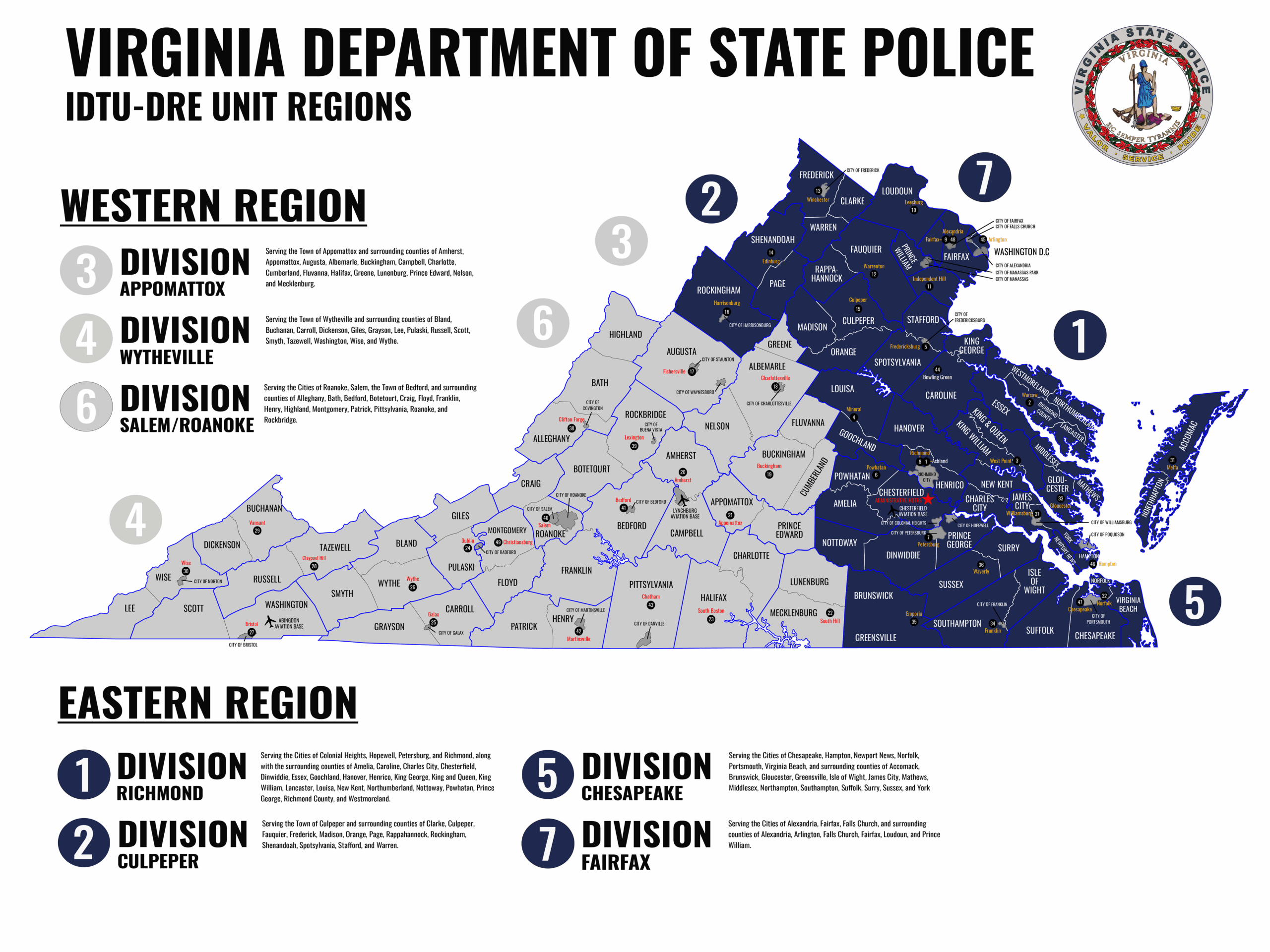
Physical Address:
Administrative Headquarters
7700 Midlothian Turnpike
North Chesterfield, VA 23235
Mailing Address:
P.O. Box 27472
Richmond, VA 23261
Attn: IDTU-DRE Unit

The Team
Christina Mann
Office Services Specialist
(804) 997-3684
Sergeant Indiana Raccanello
Eastern Region
(540) 718-0796
Sergeant John Keen
Western Region
(276) 312-2839
Sergeant Ben Davis
Western Region
(276) 285-4954
Standardized Field Sobriety Testing (SFST)
The NHTSA Standardized Field Sobriety Testing (SFST) training prepares police officers and other qualified persons to conduct field tests for use in DWI investigations. The goal of this training is to ultimately increase deterrence of DWI violations; thereby reducing the number of crashes, deaths, and injuries caused by impaired drivers. Participants should be persons employed and under the direct control of public criminal justice agencies or institutions involved in providing training services to law enforcement agencies.
SFST Instructor Development Course (SFST IDC)
The SFST-IDC is designed to enable participants to develop the knowledge and skills necessary to effectively fill roles as instructors in support of the National Highway Traffic Safety Administration (NHTSA) and International Association of Chiefs of Police (IACP) DWI Detection and SFST training program. This course will train instructors to effectively teach officers in the detection of impaired drivers and provide relevant feedback to students. Instructors will learn how to conduct interactive participant-centered training. They will develop and strengthen their presentation skills and their skills as a DWI detection and SFST instructor.
Requirements:
• Certified DCJS General Instructor
• Demonstrate proficiency in the administration of the SFSTs
• Successfully completed the NHTSA/IACP Basic SFST Training Program
Advanced Roadside Impaired Driving Enforcement (ARIDE)
Advanced Roadside Impaired Driving Enforcement, or ARIDE, is a 16-hour course intended to bridge the gap between Standardized Field Sobriety Testing (SFST) and Drug Recognition Expert (DRE) courses. Police officers, prosecutors, and toxicologists will learn how to observe, identify, and articulate the signs of impairment related to drugs, alcohol, or a combination of both to reduce the number of impaired driving incidents, serious injury, and fatal crashes. One of the more significant aspects is the review and required student demonstration of the SFST proficiency requirements. ARIDE also stresses the importance of securing the most appropriate biological sample to identify substances causing impairment.
This course is designed for those who have successfully completed the 24-hour basic SFST curriculum approved by the International Association of Chiefs of Police (IACP) and the National Highway Traffic Safety Administration (NHTSA).
- This training is not intended to be a substitute for the DEC Program
- ARIDE is a training and NOT a certification
Virginia Drug Evaluation and Classification Program (DECP)
The Drug Evaluation and Classification Program (DECP), also known as the Drug Recognition Expert (DRE) Program, is a program coordinated by the International Association of Chiefs of Police (IACP) with support from the National Highway Traffic Safety Administration (NHTSA). The training for the program is the highest level of training offered by NHTSA to combat impaired driving. The Virginia DRE Program is a collaboration of LE agencies working together.
An ARIDE-trained officer gathers additional roadside evidence from the drug-impaired suspect, but ARIDE-trained officers should request a DRE to collect evidence that will support or disprove the crime of driving while impaired by drugs and secure necessary evidence for prosecution.
Certified DREs conduct a 12-step, systematic and standardized evaluation on suspected impaired individuals to determine if impairment is present, and if it’s alcohol, medical, or drugs. If it’s determined to be drug impairment, they determine which drug category(s) are causing the impairment. The evaluation is typically one hour and is conducted at a hospital or jail, not roadside. The DRE completes an unbiased report, provides it to the officer and commonwealth attorney, and can provide expert testimony based on their training and experience. When it comes to ARIDE training and DREs, policing agencies need both.
Drug Recognition Expert (DRE)
DRE training consists of two weeks classroom, followed by a week of field certification. DRE certification is a two-year term. To apply, please complete the application below and return it to IDTU@VSP.VIRGINIA.GOV
- Application (pdf)
Course materials
Standardized Field Sobriety Testing (SFST)
- Standardized Field Sobriety Testing (SFST) Participant Manual (pdf)
- Standardized Field Sobriety Testing (SFST) Instructor Guide – Full Manual (pdf)
- Session 1 – Introduction and Overview
- Session 2 – Detection and General Deterrence
- Session 3 – The Legal Environment
- Session 4 – Overview of Detection, Note Taking, and Testimony
- Session 5 – Phase One: Vehicle in Motion
- Session 6 – Phase Two: Personal Contact
- Session 7 – Phase Three: Pre-Arrest Screening
- Session 8 – Concepts and Principles of the Standardized Field Sobriety Tests (SFSTs)
- Session 9 – SFST Demonstrations and Practice
- Session 10 – Alcohol Workshop: First Session
- Session 10 A – Dry Lab
- Session 11 – Processing the Arrested Subject, Report Writing, and Preparation for Trial
- Session 12 – Moot Court
- Session 13 – Alcohol Workshop: Second Session
- Session 13 A – Dry Lab
- Session 14 – Review and Proficiency Examinations
- Session 15 – Written Examination and Program Conclusion
- Session 16 – Introduction to Drugged Driving
SFST Instructor
- SFST Instructor Participant Manual (pdf)
- Session 1 – Introduction
- Session 2 – Starting the Learning Conversation
- Session 3 – Effective Strategies in Learning and Instruction
- Session 4 – SFST Curriculum Package and Teaching Assignments
- Session 5 – Effective Feedback, Coaching and Proficiencies
- Session 6 – Effectively Promoting Participation and Interaction
- Session 7 – Dealing with Training Challenges
- Session 8 – Developing and Using Training Aids
- Session 9 – Planning and Managing a Live Alcohol Workshop
- Session 10 – Guidelines for Conducting Video Workshops for SFST Training
- Session 11 – Course Review, Examination, Evaluation, and Wrap-Up
ARIDE
- ARIDE Participant Manual (pdf)
- Session 1 – Introduction and Overview “Drugs and Highway Safety”
- Session 2 – Standardized Field Sobriety Testing (SFST) Review
- Session 3 – Standardized Field Sobriety Testing (SFST) Proficiency Examination
- Session 4 – Drugs in the Human Body
- Session 5 – Observation of the Eyes and Additional Tests for Drug Impairment
- Session 6 – Seven Drug Categories
- Session 7 – The Effects of Drug Combinations
- Session 8 – Pre and Post Arrest Procedures
- Session 9 – Written Examination and Program Conclusion